|
|
|
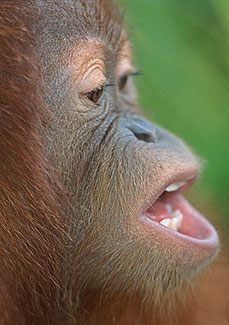
Ning Ning, Portrait # 1
|
I was
walking with my wife, Lee, when we first met Ning Ning in a park
near Kuala Lumpur, Malaysia. Ning Ning and her keeper were walking
hand in hand down a path with Ning Ning being restrained only by
the keeper's hold on her hand. When we stopped to talk to the
keeper, the small three-year-old orangutan took Lee’s hand and
pulled herself up, wanting to be held. Lee obliged, cradling Ning
Ning in her arms while the small orangutan played with her
necklace. I was struck by the gentleness of this infant being, and
her need for nurturing. The next time we saw Ning Ning she was
surrounded by a busload of tourists, and had become very agitated.
The images here were made afterward, as we tried to help calm the
baby orangutan. |
Ning Ning's
story, like that of all orangutans taken from the wild, is tragic.
Baby orangutans are in demand as pets, and the young can be
separated from their fiercely defensive mothers only by killing
the mother. The babies are then taken and sold for extremely high
prices. They often refuse to eat and are transported under
terrible conditions. Between six and eight of them die for each
one that survives. Orangutans live up to 60 years in captivity,
but once grown they have many times the strength of a human and
cease being good pets.
This cruelty, apart from the toll it takes on individual
orangutans, is a death sentence for the entire specie. Female
orangutans usually have only three or four offspring during their
lifetime. With such a low reproduction rate and so few orangutans
remaining, every individual counts. Additionally, the only
habitats that support wild orangutans are vanishing at an
astonishing rate. |
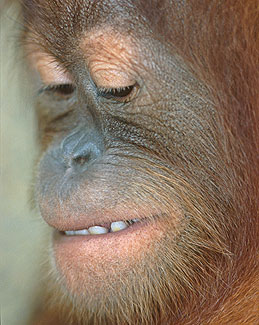
Ning Ning, Portrait # 2
|
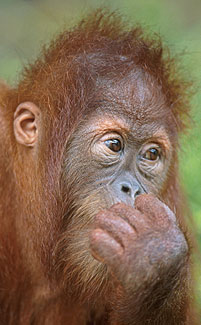
Ning Ning, Portrait # 3 |
Ning Ning has
undoubtedly experienced unimaginable trauma in the time since
her birth in the rainforest. In spite of this she remains a
gentle being. Her life is no longer traumatic, but it will be
spent captive among humans, in a world where she does not
belong. |
|
|


