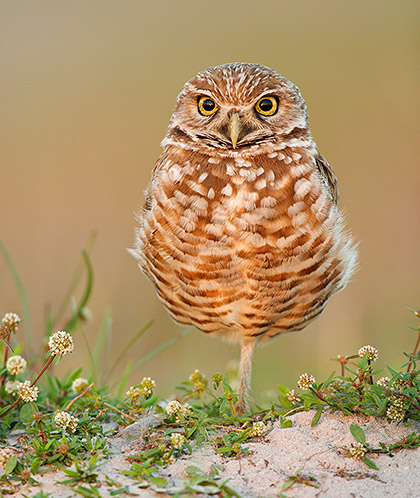
Burrowing Owl in Clover, Cape Coral, Florida
(Click image to enlarge)
The Florida burrowing owl (Athene cunicularia) gets its name because it lives in holes burrowed into the ground. It usually nests in the old burrows of ground squirrels, badgers, or other small mammals, although it may dig its own burrow in soft soil. Burrowing owls are one of the smallest owl species at about 9 inches tall and 4 ounces in weight. When agitated a burrowing owl will bob its head, bow with a quick bending motion of the legs, and make an alarm call very similar to the sound of a rattlesnake. It then dives very quickly into its burrow if further threatened.
The burrowing owl's status is listed as a "species of special concern" in several states because its numbers are rapidly declining. The Florida Fish and Wildlife Conservation Commission once estimated the statewide population at between 3,000 and 10,000 pairs. Within the past 20 years, and particularly within the past 5 years, the numbers have declined sharply. The main threat to the owl's survival is destruction of its habitat caused by increased residential and commercial development.