Dean M. Chriss
Photography
When Handed Lemons...
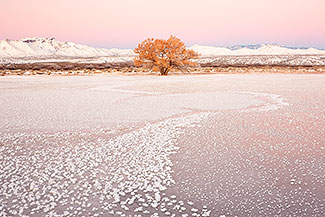
Pond and Tree, Winter Dawn, New Mexico
The ponds where geese and sandhill cranes usually roost overnight were completely frozen and without any birds. We also learned that the corn crops planted in the refuge had failed, and due to the bad economy farmers that usually act as a backup supply had gone out of business, so the birds were much more widely dispersed than usual. After a few subzero mornings things started warming up a little, but after a couple of nice days the next big storm arrived. Instead of the threatened snow it brought rain, and lots of it. The rain created patches of deep vehicle stranding mud. It was indeed miserable, and in my opinion worse than the subzero temperatures that began our little trip. I saw only two other people on one day, which is extremely unusual for an area that's typically full of photographers and bird watchers. Both were birdwatchers, so apparently all of the photographers had a nice breakfast at the El Camino and spent the day in their motel rooms going through images they captured in nicer weather. There was very little bird activity indeed. Most of the cranes were apparently grounded by the rain. They just searched for food or slept, like most of the photographers. When the rain would lighten up or stop for a few minutes a few cranes would use the opportunity to fly to a different field, but that was about all that was happening.
This trip was certainly not what I expected, but in spite of what would seem to be an awful set of events it was wonderful. Unless it lasts too long, I find bad weather and other unusual conditions exciting because they always bring the possibility of capturing unique images that would otherwise be impossible. Our 'bad' circumstances in New Mexico produced icy landscape photographs, off-white gypsum dunes frosted with pure white snow, and wildlife scenes shrouded in etherial mist. Of course it was wet and miserable at times, and the photos were few and far between, but they are more worth having than any I'd have gotten 'machine gunning' images of flying birds on a 'nice' day. The real key to making a success out of bad situations is to be flexible. Instead of looking for what you'll never find, look for what is there. There's nearly always something to photograph. The next time you're handed some lemons, try making some lemonade. Once in a while it will turn out sour, but it's usually nice and sweet.
Happy shooting,
Dean