The Fight for the Arctic - A One-Way War of Attrition
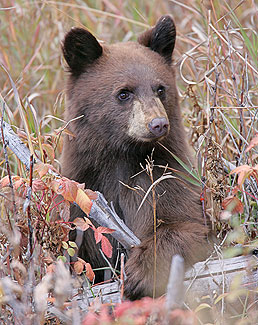
Black Bear Cub
When it comes to land use every loss of wilderness is permanent. The destroyers make many attempts to gain access over many years, and they only need to succeed once. The odds are stacked heavily in their favor. Mines, oil fields, and other industrial developments never revert to forests, wetlands, or prairies. Profiteers destroy an area and then move on to something else. There are always greedy people eager to profit from environmental destruction, so the cycle is endless. Our shared environment is eroded over time and we find ourselves in a less hospitable world, with less wilderness, dirtier water and air, and a diminished legacy for the future. This is the world promised by Donald Trump and his supporters.
For 40 years between 1977 and 2017 environmentally unconscious politicians, fueled by political contributions from the oil lobby, tried to open the Arctic National Wildlife Refuge to oil drilling. Until late 2017 their efforts were unsuccessful due to public opposition. In spite of the oil crisis of 1979, countless more minor oil shortages, and gasoline prices in excess of $4 per gallon, America did well without drilling in the Arctic National Wildlife Refuge. Now in 2017 there is a glut of petroleum, low gasoline prices, oil boom towns going bust in North Dakota for lack of profits, and absolutely no economic justification for opening more land to oil drilling, but that is exactly what our maniacal President and his radicalized party have done. The richest multinational companies on earth will now become a little richer and one of the most biologically rich and beautiful places in the world will become an industrial wasteland.
There were numerous reasons to preserve the Arctic National Wildlife Refuge:
1. Oil from the Arctic National Wildlife Refuge represents a fortune for a few large corporations, but it is not significant in terms of our energy independence or the price we pay at the gas pump. Potential oil reserves in the Arctic National Wildlife Refuge are tiny when compared to those in the existing Prudhoe Bay oil fields, much less those in the rest of the U.S. and around the world. World demand and supply controls the price of oil. This also neglects the fact that the entire world, except for America, is moving away from fossil fuels. Even Saudi Arabia is making plans to diversify and move away from an oil based economy. Norway, India, the Netherlands, and Germany are planning to completely phase out the sale of gasoline powered vehicles in less than 40 years. Even China is prodding its auto makers to expand their production of electric vehicles, and one manufacturer just just invested $735 million to boost electric vehicle output. China now has strict limits on the number of new vehicles that can be registered in some cities, with electric vehicles being exempt.
2. It would take about ten years of environmental destruction in the form of mining, road building, industrial construction, and drilling, before any oil from the Arctic National Wildlife Refuge could reach consumers. Then most of the consumers will be in countries other than the United States. There is no guarantee that oil from the refuge would ever reach American consumers. In fact, the same legislation that opens the Arctic national Wildlife Refuge to drilling allows the oil obtained there to be exported.
3. A one mile per gallon improvement in the efficiency of the average automobile would save a half million barrels of oil each day, forever. That’s far more than we can ever hope to extract from the Arctic refuge. In total, the Arctic National Wildlife Refuge contains approximately the amount of oil the United States uses in one year. The oil companies will destroy America’s largest and finest remaining wilderness for their own gain, leaving a wasteland when they are finished. Their track record speaks for itself.
4. Many politicians and the oil industry falsely claim (lie) that the "footprint" of development would be less than the size of Dulles International Airport outside Washington, D.C. That ridiculous claim counts only the area of the oil drilling pads themselves. It does not include the industrial complex that would spread like a spider web across virtually the entire coastal plain. Supporting the oil drilling pads requires hundreds of miles of roads and feeder pipelines, refineries, living quarters for hundreds of workers, sanitary facilities, landfills, water reservoirs, docks and gravel causeways, production plants, gas processing facilities, seawater treatment plants, power plants, and huge gravel mines. Gravel is usually mined from river beds, destroying fisheries in the process. It should be obvious to anyone that such activities will change what is literally America's most pristine wilderness into another dirty and remote industrial area.
5. Despite lies by politicians and oil companies that they can and have drilled responsibly on Alaska’s North Slope, spills are commonplace. On average, there’s more than one spill per day of crude oil, refined oil products or hazardous substances on Alaska’s North Slope at Prudhoe Bay. In 1999 alone, these spills released 45,000 gallons of crude oil, diesel fuel, propane and ethylene glycol, among other toxic substances. Oil is also released into the arctic environment through leaks in the Trans-Alaska pipeline system.
6. In the course of normal operations North Slope oil and gas operations generate enormous amounts of waste. All of it is exempt from hazardous-waste regulations because of a loophole in the law. As a result, millions of gallons of oily liquids and sludge, toxic brine and other wastes are dumped into open pits, frozen into the permafrost or simply discharged into the environment.
7. The Arctic national Wildlife Refuge is one of the largest intact ecosystems left in the world. It is the largest and most biologically diverse ecosystem remaining in America. It is home to the largest U.S. population of polar bears. This habitat is increasingly important as sea ice diminishes and polar bears are increasingly forced onto land. It is also home to the Porcupine Caribou herd, numbering 200,000 animals. The Gwich’in people have survived by living on this land and its bounty for millennia. Nearly 200 species of birds migrate from the Arctic refuge to the lower 48 states and through our backyards. It's important to realize that many common American bird populations have plummeted by over 70% since 1967 due mostly to habitat destruction elsewhere. The area of the most concentrated drilling in the refuge, the coastal plain, is also the most sensitive. It is the place where the Porcupine caribou herd migrates to have their young and where countless wild birds spend the summer months. The difference between drilling the coastal plain and the rest of the refuge is like the difference between putting a needle in your arm or into your heart. Biologists project that the birthrate of the Porcupine caribou may fall by 40 percent. The effects on the many birds, bears, musk oxen, and other wildlife is largely unknown.
8. Drilling for oil in the Arctic National Wildlife Refuge sets a precedent that endangers all of America's wild lands. If we cannot protect the integrity of the Arctic National Wildlife Refuge, how can we hope to protect any of our wild lands? The simple answer is that we cannot. To see this we need look no further than Alaska's Izembek National Wildlife Refuge. It was first set aside in 1960 by President Dwight Eisenhower and it became a national wildlife refuge in 1980. Most of the refuge was officially designated as wilderness, the most protective designation possible. The place is a refuge for tundra swans, brown bears, caribou, wolves, and each fall the entire world population of black brant geese. Hundreds of thousands of salmon spawn there. Izembek Lagoon contains one of the largest eelgrass beds in the world, providing food and shelter for the birds. Now the Trump administration is proceeding with plans to cut a road through the Izembek Wilderness. The road is supposedly for safe passage in emergencies in spite of the fact it would be impassable for much of the year. To address this concern $50 million taxpayer dollars have already gone to King Cove, a town of a few hundred people, for alternatives including hovercraft and a local clinic. So what's the problem? The answer lies in a 1994 King Cove city resolution stating the road would link "North America's largest salmon cannery in King Cove with one of the state's premier airports at Cold Bay". The cannery is Japanese owned. Again, it all boils down to pure greed. A previous four-year study determined the road would cause irreversible damage to the refuge and the wildlife that depend on it.
To build his American corpocracy Trump appointed Scott Pruitt, who formerly spent his career suing the EPA, to head the agency and destroy it from within. Pruitt has replaced EPA scientists with "scientists" from industry whose goal is protecting industry over the environment. More than 700 EPA employees have left the agency since Trump took office, including more than 200 scientists. Thanks to Trump and his party America can no longer rely on the institutions tasked with protecting its people and resources.
There are far too many examples to go into here and new ones come up on a daily basis. It will suffice to say that with greed on their side the destroyers eventually win. America has proven itself incapable of setting aside and preserving anything in a natural state. It is only a matter of how long it will take to spoil everything we have.
Dean